
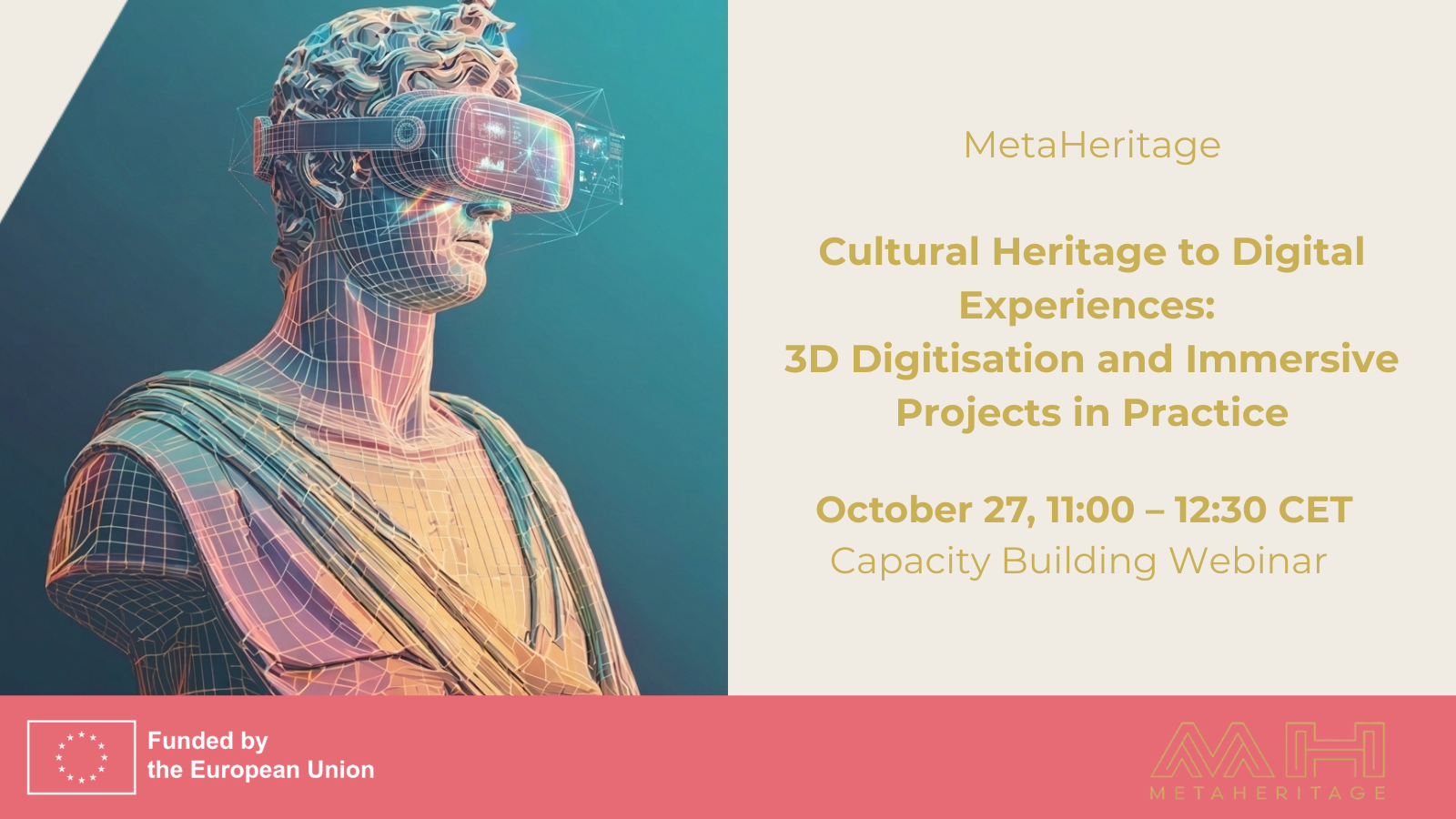
What happens when a historic object, building, or cultural story moves beyond the physical world and becomes a digital experience?
From detailed 3D models and virtual restorations to augmented and mixed reality exhibitions, digital technologies are opening new ways to document, preserve, interpret and experience cultural heritage. But behind every immersive experience is a process: capturing heritage assets, processing digital data, building 3D environments and ultimately turning this material into something audiences can explore and interact with.
On 27 October 2026, our webinar Cultural Heritage to Digital Experiences: 3D Digitisation and Immersive Projects in Practice will take a practical look at this process, bringing together two practitioners working at the intersection of heritage, technology and creative storytelling.
From documentation to digital experience
Alexandre González Rivas, historian and 3D artist specialising in cultural heritage digitisation and virtual restoration, will explore the technologies behind the digital capture of heritage.
His session will introduce participants to tools and techniques including photogrammetry, laser scanning and LiDAR, as well as 3D modelling and the development of AR and VR experiences. The focus will not only be on the technologies themselves, but also on how they fit together within a practical workflow.
What does it take to move from a physical heritage asset to a finished digital model? And how can that model then become the foundation for a virtual tour, an immersive exhibition or another digital experience?
Alexandre will address these questions and demonstrate the process in practice.
When heritage meets immersive storytelling
Technology is only one part of the equation. Digital heritage experiences also need compelling narratives and meaningful ways for audiences to engage with content.
Emilia Gozzano, award-winning film director and XR artist, works across animation, immersive storytelling and interactive media. Her projects include AR and VR experiences for cultural heritage exhibitions, as well as creative projects that transform analogue content into interactive experiences.
Her contribution will show how XR can extend the possibilities of heritage interpretation — creating experiences that invite audiences not simply to look at cultural content, but to explore and interact with it.
A journey from asset to experience
The webinar will bring these perspectives together in a practical programme.
Participants will first explore the technologies and approaches used in 3D digitisation and immersive heritage projects. They will then see how these technologies are applied in real-world cultural heritage and XR projects before following a practical workflow from photogrammetry and 3D modelling to texturing, lighting and final rendering in Unreal Engine.
The result is a behind-the-scenes look at what it takes to transform cultural heritage into a digital experience.
Cultural Heritage to Digital Experiences: 3D Digitisation and Immersive Projects in Practice takes place online on 27 October 2026, from 11:00 to 12:30 CET.
Whether you are a heritage professional, museum practitioner, researcher, creative professional or simply interested in the potential of digital technologies for culture, the webinar offers an opportunity to discover practical approaches, real-world projects and creative possibilities.
Join us and explore how 3D digitisation and immersive technologies can create new ways of connecting people with cultural heritage.





Leave A Comment